


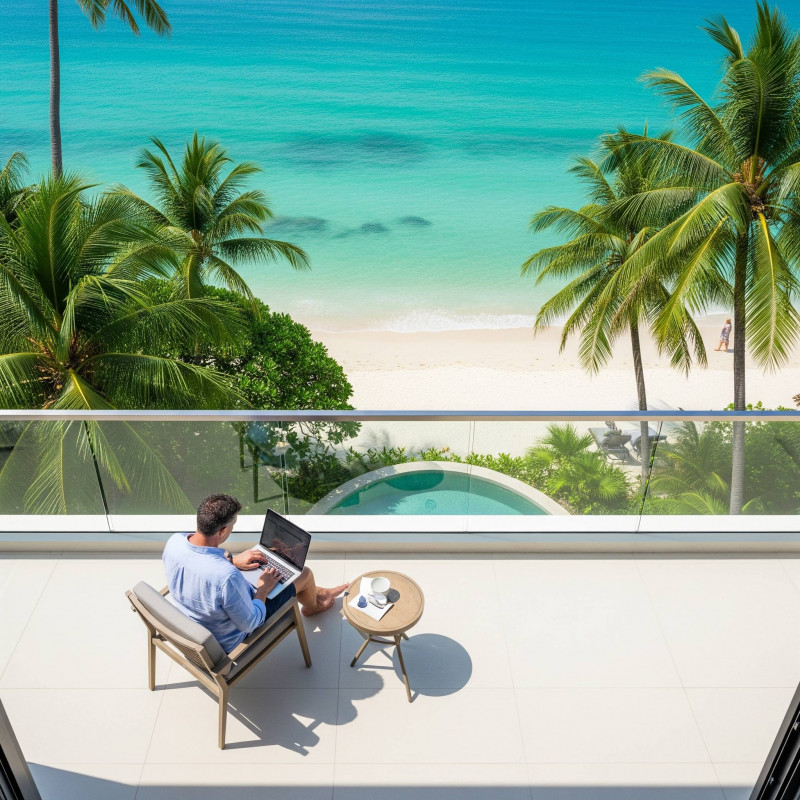
Thailand launched the Destination Thailand Visa (DTV) on July 15, 2024. This visa targets remote workers and digital nomads, aiming to establish Thailand as a hub for long-term visitors and to boost the economy.
I. What Exactly is the Destination Thailand Visa (DTV)?
The Destination Thailand Visa (DTV) is a multiple-entry visa for remote or freelance work for foreign nationals.
The DTV caters to three primary categories:
- Workcation: For digital nomads, remote workers, foreign talent, and freelancers employed by or serving clients outside of Thailand.
- Thai Soft Power Activities: For individuals participating in activities promoting Thai culture, such as Muay Thai training, Thai culinary courses, sports training, medical treatments, academic seminars, and music festivals.
- Spouse and Children: Legal spouses and dependent children under 20 years of age of the primary visa holder are eligible.The "Thai soft power activities" category aims to leverage cultural assets for economic benefit, encouraging active participation in local industries and fostering deeper engagement with the economy and culture.
II. The DTV Advantage: Benefits for Your Thai Journey
Long-Term Stays: Unpacking the 5-Year Multiple-Entry Validity: DTV applicants receive a five-year multiple-entry visa. This allows unlimited entries and exits within the five-year period without re-entry permits.
Extended Horizons: Maximizing Your 180-Day Stays with Extensions Up to 360 Days: Each DTV entry permits a stay of up to 180 days.
Work-Life Balance: Legally Working Remotely for Overseas Employers: DTV holders are authorized to work remotely for companies or clients not based in Thailand.
Cost-Effectiveness: A Look at the DTV's Affordability Compared to Other Long-Term Options: The DTV is a cost-effective alternative to other long-term visas. The base application fee is approximately 10,000 baht ($291 USD).
III. Eligibility Checklist: Are You Ready for Thailand?
Prospective DTV applicants must meet specific criteria.
Age Requirement: Primary applicants must be at least 20 years old.
Financial Foundation: The Crucial 500,000 THB Liquid Funds Requirement: Applicants must show a minimum ending balance of 500,000 THB (approximately $14,400 to $16,000 USD) in a saving or checking bank account.
Table 1: DTV Financial Requirements at a Glance
| Requirement | Details |
|---|---|
| Minimum Required Balance | 500,000 THB |
| Approximate USD Equivalent | $14,400 - $16,000 USD |
| Required Duration of Balance | Minimum 3 months (some embassies may require 3-6 months) |
| Acceptable Forms of Proof | Bank Statement, Payslips, Sponsorship Letter |
| Important Note | Only liquid funds (cash in bank account) are accepted. Stocks, bonds, cryptocurrency are not valid. |
Proof of Purpose: What Documents You'll Need to Show
Documents vary by category:
- For Workcation (Digital Nomad/Remote Worker/Freelancer): Employment contract or certificate from home country, or a professional portfolio. Proof of salary slips or monthly income for the last six months is mandatory.
- For Thai Soft Power Activities: Letter of acceptance from the organizing institute or company (e.g., Muay Thai gym, cooking school). For medical treatment, a letter of appointment from a hospital or medical center.
Important Note: Understanding the "No Local Employment" Rule
The DTV does not permit employment with Thai companies. It is for remote work for foreign entities or approved soft power activities. Work for a Thai employer requires a separate work permit and visa.
IV. Navigating the Application Process: Your Step-by-Step Guide
Where to Apply: Online via the E-Visa Portal or at Thai Embassies/Consulates Abroad
DTV applications must be submitted from outside Thailand.
Online Application: As of February 2025, applications are primarily through Thailand's official e-Visa portal (thaievisa.go.th).
In-Person Application: Applications can also be made in person at a Royal Thai Embassy or Consulate in the applicant's home country or country of employment. Contact the specific embassy/consulate for requirements, as some may only accept online applications.
**The DTV's recent launch and online system transition mean the framework is still maturing. Fee variations and processing inconsistencies exist, requiring applicants to confirm local embassy practices.
Essential Documents: A Concise Checklist
Prepare the following documents:
- Valid passport (at least six months validity, two blank pages).
- Recent passport-sized photograph (last six months).
- Proof of financial stability (bank statements showing 500,000 THB balance for past 3-6 months, recent payslips, or sponsorship letter).
- Proof of employment, business ownership, or freelancer status (employment contract, company registration, or professional portfolio).
- Proof of current location (driving license, bank statement, utility bill, or lease agreement).
- Health insurance coverage (specific details not extensively provided in research material).
- For dependents: marriage certificate, birth certificate, or adoption papers, plus primary DTV holder's visa approval.
Visa Fees: What to Expect for the Application and Extensions
The DTV application fee varies by country, ranging from ฿9,275 to ฿39,471.
The extension fee for an additional 180 days is 1,900 THB as of 2025.
Table 2: DTV Application Fees by Country (Selected Examples)
| Country of Application | Official Visa Fee (Local Currency) | Converted to THB (Approx.) |
|---|---|---|
| United States | 400 USD | ฿13,057 |
| United Kingdom | 300 GBP | ฿13,285 |
| Australia | 600 AUD | ฿12,764 |
| Canada | 650 CAD | ฿15,511 |
| Japan | 52,000 JPY | ฿11,766 |
| China | 10,000 THB | ฿10,000 |
| India | 25,000 INR | ฿9,538 |
| New Zealand | 2,000 NZD | ฿39,471 |
| Germany | 350 EUR | ฿13,053 |
| Singapore | 500 SGD | ฿12,696 |
| Malaysia | 1,600 MYR | ฿12,330 |
| Vietnam | 340 USD | ฿11,099 |
Note: Conversions are approximate and subject to exchange rate fluctuations.
Processing Times: How Long You Might Wait for Approval
DTV applications via the e-Visa portal typically take 7-10 business days for approval.
V. The Unvarnished Truth: Challenges and Practicalities
Prospective and current DTV holders should be aware of challenges and evolving regulations.
The Banking Conundrum: Why Opening a Thai Bank Account Can Be Tricky for DTV Holders:
DTV holders often face difficulty opening or maintaining Thai bank accounts. Many Thai banks classify the DTV as a "tourist visa" for banking purposes.
This is due to updated Anti-Money Laundering (AML) laws and anti-fraud measures. Banks require visas that classify individuals as long-term legal residents, which the DTV, as a "tourist-linked visa," currently does not meet.
The DTV's classification as a "tourist-linked visa"
Table 3: Thai Bank Policies for DTV Holders (As of May 2025)
| Bank Name | Current Policy for DTV Holders | Primary Reason for Policy |
|---|---|---|
| Bangkok Bank | Stopped opening new accounts; existing accounts under review/closure reports | Classified as tourist visa; AML/Anti-fraud measures |
| Kasikorn Bank (KBank) | Does not allow account openings for DTV holders | Classified as tourist visa; AML/Anti-fraud measures |
| Krungsri Bank | As of Feb 2024, no longer opens accounts for DTV holders | Classified as tourist visa; AML/Anti-fraud measures |
| Siam Commercial Bank (SCB) | Policies vary by branch; some success, some denials | Discretion at individual branches; underlying AML concerns |
Practical tips and potential solutions for managing finances: Accredited Muay Thai gyms (e.g., FITFAC) offer services to assist DTV holders in opening bank accounts, requiring extensive documentation from the school.
Extension Realities: Navigating the 180-Day Extension Process and the Common "Border Bounce" Alternative:
While the DTV allows a single 180-day extension per entry, reports indicate difficulties obtaining this at local immigration offices.
Many DTV holders opt for a "border bounce" (briefly leaving and re-entering Thailand) to reset their 180-day stay, avoiding extension complexities.
Tax Implications: Understanding Tax Residency and Potential Obligations on Foreign Income:
If a DTV holder spends more than 180 days in Thailand within a calendar year, they are generally considered a Thai tax resident.
Evolving Landscape: Acknowledging the Dynamic Nature of Visa Regulations:
The DTV is a new initiative, and its framework is evolving. Reports indicate "visa conditions changing every few months" and inconsistencies across Thai embassies, consulates, and local immigration offices.
VI. Beyond the Visa: DTV's Impact on Thailand's Tourism and Economy
The DTV is central to Thailand's strategy to revitalize tourism and stimulate economic growth. Attracting long-term visitors, especially digital nomads, is expected to increase spending across accommodation, food, local services, and cultural activities.
Conclusion: Your Thai Adventure Awaits!
The Destination Thailand Visa offers an accessible pathway for digital nomads, remote workers, and cultural enthusiasts to experience Thailand for extended periods. Its five-year multiple-entry validity and potential for continuous year-long stays are significant advantages.
However, understanding challenges related to opening a local Thai bank account and visa extensions is crucial. While the DTV is a promising development, staying updated on regulations and planning for financial and logistical aspects are paramount for a smooth experience.
Thailand is invested in attracting global citizens. With preparation and awareness, living and working in Thailand can become a reality.
Table 4: DTV vs. Other Long-Term Thai Visas (Comparison)
| Feature | Destination Thailand Visa (DTV) | Thailand Privilege Card (Elite Visa) | Long-Term Resident (LTR) Visa |
|---|---|---|---|
| Primary Target Audience | Digital nomads, remote workers, freelancers, soft power participants | Affluent individuals, investors, frequent visitors seeking premium services | Wealthy global citizens, wealthy pensioners, remote workers, highly-skilled professionals |
| Validity Period | 5 years | 5 to 20 years (depending on package) | 10 years |
| Max Stay per Entry | 180 days (extendable to 360 days) | 1 year (renewable annually within validity) | 1 year (renewable annually within validity) |
| Approximate Application Cost (THB) | ฿9,275 - ฿39,471 (varies by country) | ฿650,000 - ฿5,000,000+ | ฿50,000 (application) |
| Key Financial Requirement | ฿500,000 liquid funds (3-6 months history) | Varies by package; no specific liquid fund requirement for application, but high membership fee | US$80,000 annual income (for remote workers); significant investment/assets for others |
| Local Employment Allowed? | No | No | Yes (with work permit) |
| Tax Exemption on Foreign Income? | No (taxable if remitted after 180 days residency) | No (taxable if remitted after 180 days residency) | Yes (exempt from Thai income tax on foreign-source income) |
| Ease of Banking | Difficult (classified as tourist visa by banks) | Easy (full acceptance by major banks) | Generally easy |
| 90-Day Reporting Required? | Yes | Yes (often facilitated by Privilege Card staff) | No |
Sources: JSCE, The Nation Thailand, Bangkok Post, Thailand PRD, Airports of Thailand, Global Citizen Solutions, Travel and Tour World, Locality Guide, The Chicago Athenaeum, Airport Technology, Airport Suvarnabhumi, U.S. Department of Commerce, DTV.in.th, GetWorkFlex, BDO Global, Reddit, Pattaya Mail, Siam Legal, Immigration Bureau, Nomad Visa Malta, Thai Embassy, Travellerspoint, Greenback Tax Services, Tourism Authority of Thailand, ThaiLawOnline.


