


Executive Summary: Bridging an 11-Year Divide
United Airlines is making a significant play in the competitive Transpacific market. After an 11-year hiatus, the airline is resuming service between Los Angeles (LAX) and Bangkok (BKK) starting in late October 2025.
This move is far more than a simple schedule update. It represents a major strategic commitment by a North American carrier to capture market share in the booming Southeast Asian travel sector.
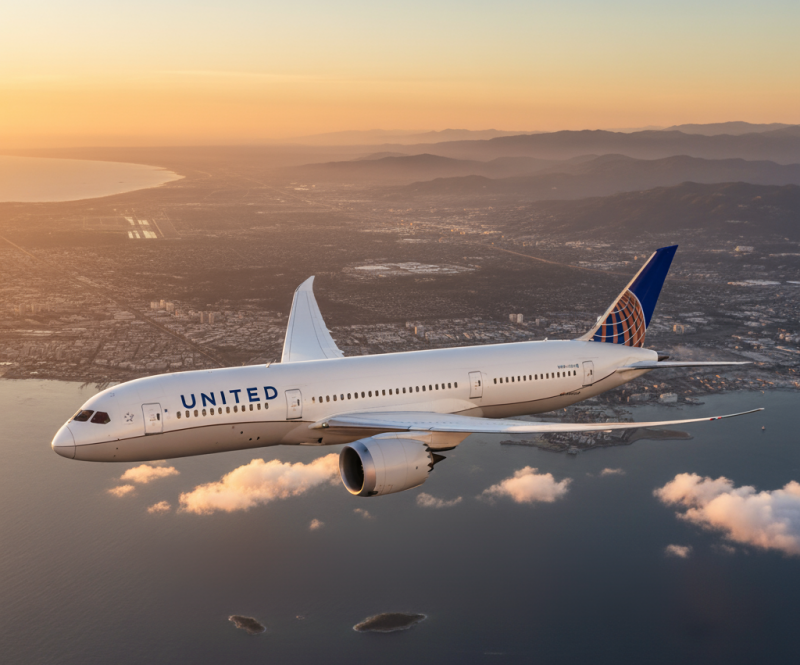
The daily service operates via a crucial intermediate stop in Hong Kong (HKG) , utilizing the highly efficient Boeing 787-9 Dreamliner. This optimal routing instantly positions United as a key link between North America and Thailand, which remains the principal entry point into Southeast Asia.
The decision to return is backed by strong global economic data. Aviation forecasts point to Asia leading global air travel growth, complementing a steady demand for international leisure travel among U.S. consumers. This analysis dives into the operational strategy, the underlying reasons for the relaunch, and the competitive challenges United will face.
Flight Details | Outbound (UA 820) | Inbound (UA 821) |
Route | Los Angeles (LAX) - Hong Kong (HKG) - Bangkok (BKK) | Bangkok (BKK) - Hong Kong (HKG) - Los Angeles (LAX) |
Frequency | Daily 3 | Daily 3 |
Aircraft | Boeing 787-9 Dreamliner 1 | Boeing 787-9 Dreamliner 1 |
Seat Capacity | 257 Seats (Polaris, Premium Plus, Economy) 1 | 257 Seats (Polaris, Premium Plus, Economy) 1 |
Strategic Advantage | Provides seamless SFO connection via HKG 2 | Reaffirms BKK as gateway to Southeast Asia 1 |
Strategic Rationale: Capturing the Asia Uplift
United’s timing for re-entering the Bangkok market is based on compelling global and regional trends. The global aviation sector has largely recovered to 2019 capacity levels. Critically, the resurgence of the Southeast Asian aviation market, which saw over 80% passenger traffic decline during the pandemic, is strategically vital for the region's overall economic recovery.
Macroeconomic Drivers: Asia as the Growth Engine
The commitment of long-haul capacity to Bangkok aligns with strong global forecasts: Asia is projected to drive global air travel growth.
Industry analysis suggests Asia will account for an enormous 50% of global air passenger growth over the next 15 years. Furthermore, the continent is expected to claim a 35% global share of leisure travel spending by 2025. These figures confirm that capacity expansion into key Asian markets is essential for any major global carrier aiming for sustained growth. United is directly leveraging this "Asia Uplift" as part of its aggressive international network expansion.
Localized demand in Thailand further justifies this daily widebody service. The Tourism Authority of Thailand (TAT) forecasts the nation will welcome 40 million international visitors in 2025.
This strong demand signal provided the strategic justification for the route. The importance of the connection was highlighted when senior officials, including the U.S. Ambassador to Thailand, Mr. Robert F. Godec, welcomed the inaugural flight.
Competitive LAX-Asia Long-Haul Gateway Services
Airline | LAX Destination | Service Type | Strategic Implication for UA BKK Route |
Singapore Airlines | Singapore (SIN) | Non-stop | Direct competition for deep Southeast Asia travelers; benchmark for premium service.10 |
Korean Air / Asiana | Seoul (ICN) | Non-stop | Strong Star Alliance/regional hub competition; high-frequency connection alternative.10 |
ANA (All Nippon Airways) / JAL | Tokyo (NRT/HND) | Non-stop | Primary North Asia transfer hub competition; leveraging Japanese feed.10 |
Cathay Pacific | Hong Kong (HKG) | Non-stop | Direct competition on the crucial LAX-HKG leg; UA is competing for connecting feed.10 |
China Airlines | Taipei (TPE) | Non-stop | Gateway to North Asia and potential one-stop for SEA destinations.10 |
Philippine Airlines | Manila (MNL) | Non-stop | Direct competitor targeting the growing Philippine market (UA also expanding SFO-MNL).8 |
United Airlines | Bangkok (BKK) | One-stop (via HKG) | UA’s unique offering: utilizes network breadth and US feeder traffic to overcome non-stop speed disadvantage. |
If current market trends hold—especially the strong outbound U.S. spending and Thailand's goal of 40 million visitors in 2025 —analysts anticipate future capacity increases. This could mean increased frequency or the use of larger capacity aircraft. The success of the LAX-HKG-BKK route will be a vital measure of United’s ability to compete effectively against world-class Asian carriers. This strategic blueprint positions United not just to recover, but to aggressively lead the North American penetration into Southeast Asia.


