


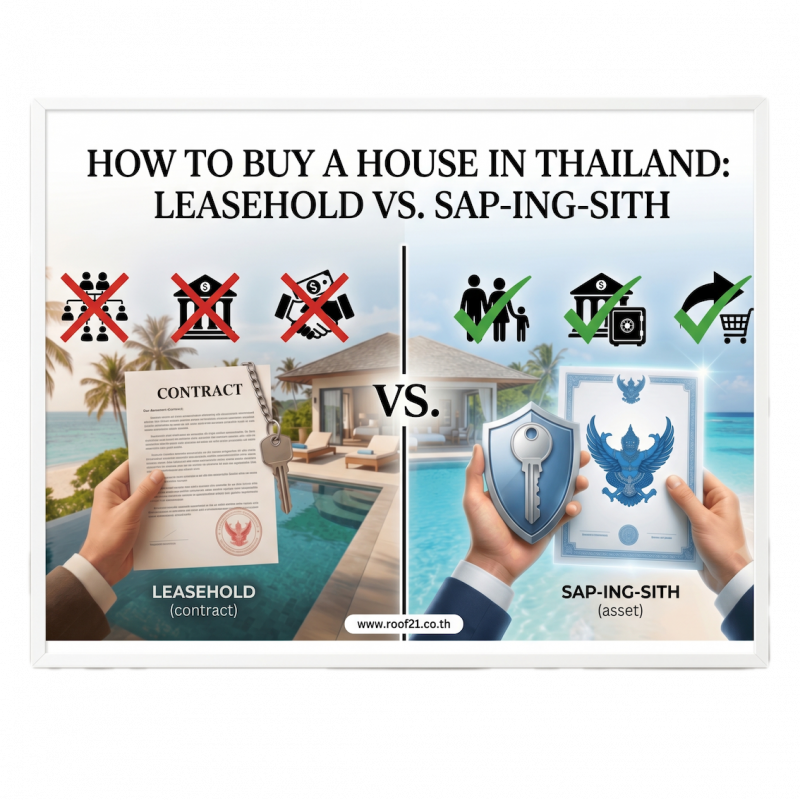
Dreaming of your own villa in Phuket, Koh Samui or Pattaya ? Thailand attracts investors from all over the world with its climate, culture and high potential for appreciation. However, Thai law does not allow foreigners to own land directly in personal ownership (Freehold). Does this mean the end of your dream of a house by the sea? Not at all.
The key to safe and legal investing is to understand the difference between a traditional leasehold agreement and the modern institution of registered real estate law, known as Sap-Ing-Sith .
How to properly buy a house in Thailand with a registered right of use?
If a foreigner buys a villa or house in Thailand, the standard and legal procedure is that they can own the building itself directly in their name , but they must lease the land underneath for a period of 30 years (which is the maximum allowed by Thai law).
For many years, the only option was the so-called standard Leasehold. However, this system had certain loopholes in terms of protecting foreign investors. The Thai government realized this and in 2019 introduced a regulation: Sap-Ing-Sith (Registered Right to Real Estate) . This new format changes the 30-year lease from a simple personal contract to a registered right registered at the Land Office.
What is a standard Leasehold?
A traditional Leasehold is legally a personal contract between you and the property owner. Although it is registered on the back of the title deed (Chanote) at the Thai Land Registry, it is still “only” a civil law relationship.
The main disadvantages of Leasehold:
Restricted disposal of property: If you want to sell your lease to someone else after 10 years, you need the express consent of the landowner, who must sign a new contract with the new buyer.
Inheritance risk: Under Thai law, a lease normally ends upon the death of the tenant. Although lawyers add inheritance clauses to contracts, their enforcement in court can be complicated if the property owner does not agree.
Prohibition of subletting: You cannot legally sublet the property to third parties without the written consent of the landowner .
What is Sap-Ing-Sith (Right to Leasehold Property)?
Sap-Ing-Sith is a modern certificate (issued with the symbol of the Blue Garuda) that takes the rights of foreigners to a whole new level. This institute is not only governed by the Civil Code, but also by a special law on Sap-Ing-Sith.
If the property is registered in the Sap-Ing-Sith system, the lease becomes a real right . You become the absolute master of the property for a full 30 years.
Why is Sap-Ing-Sith the best and legally safest choice?
If you are looking for an answer to the question of how to safely invest in real estate in Thailand, Sap-Ing-Sith is the clear winner . Here are the main reasons why we recommend this format:
Independence from the owner: With a classic Leasehold you are to some extent at the mercy of the Thai owner. With Sap-Ing-Sith you don't need him for anything. You can sell, renovate or rent your property commercially at any time without having to ask him.
Security for your family: As an investor, you want to be sure that in the event of unexpected events, your assets will be inherited by your family without any problems. The Sap-Ing-Sith Act guarantees that this right automatically becomes part of the inheritance procedure.
Higher resale value: Because Sap-Ing-Sith is perceived as a more secure and stable institution, properties with this type of ownership hold their market value much better and are much more attractive to subsequent buyer
Invest in Thailand safely with experts
Buying a home in Thailand is an excellent investment if you know how. Choosing the right legal structure is a critical step that will protect your money. Leave nothing to chance and avoid outdated and risky contract formats.
Are you planning to buy a villa or apartment in Thailand? Contact ROOF21 – your Slovak partner in Asia. Our experts will guide you through the entire process, provide a complete legal audit and ensure that your home in Thailand is secured in the most modern and safest way – Sap-Ing-Sith law. Contact us today !


